The Good News
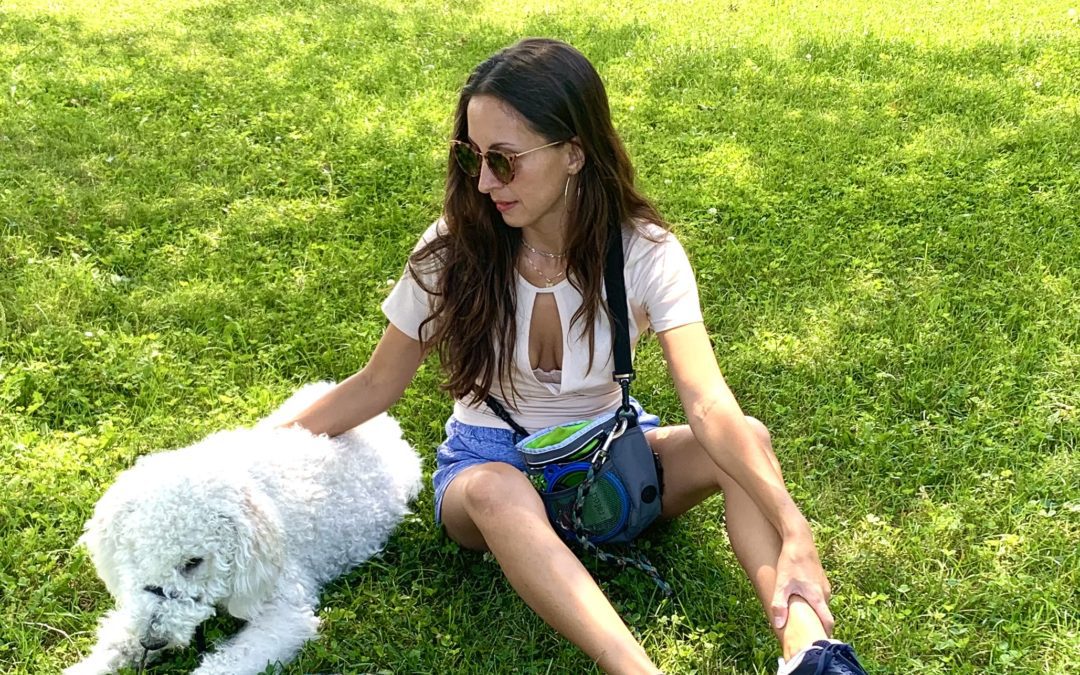
Research studies show us that a bonded human-dog relationship can help steady our nervous systems simply through everyday interaction.
When our dogs help us to have a better HRV (see details on HRV below), this means that:
- Our bodies are more flexible and better at calming down after stress.
- We bounce back faster after emotional moments, sleep more soundly, and feel less tense or worn down.
- Over time, the small moments with our dogs can add up to feeling more emotionally steady, handling daily stress more easily, and feeling more at ease in day-to-day life.
The Research
Research studies from Finland and Japan show that caring for and interacting with our dogs improves heart rate variability (HRV) which is a key sign of how well the nervous system handles stress. In the study from Finland by Koskela and colleagues (2024), researchers found that when people spent time with their dogs through calm attention, shared activity, or gentle touch, their HRV changed in healthy ways and even synced with their dog’s HRV. This means that our nervous systems become more balanced and less stuck in “high alert” from everyday stressors.
Studies from Japan, led by Kikusui and research teams at Azabu University, found similar results. During attachment moments such as coming home after being away for a while or when a dog seeks closeness, the humans showed HRV patterns linked to stronger parasympathetic (calming) activity.
The Even Better News
The research shows that these benefits don’t come from special training or therapy; they grow out of normal dog care. Paying attention to our pups, responding when they want closeness, going for walks, and sharing quiet time all give the nervous system regular chances to relax and reset.
References:
Kikusui, T., Yoshida, K., & Nagasawa, M. (2023). Heart rate variability responses of owners during dog attachment and reunion contexts. Journal of Physiological Anthropology, 42, Article 9. https://doi.org/10.1186/s12576-023-00863-7
Koskela, M., Hakanen, E., Tiira, K., Hielm-Björkman, A., & Lohi, H. (2024). Behavioral and emotional co-modulation during dog–owner interaction measured by heart rate variability and activity. Scientific Reports, 14, Article 76831. https://doi.org/10.1038/s41598-024-76831-x
Nagasawa, M., Mitsui, S., En, S., Ohtani, N., Ohta, M., Sakuma, Y., Onaka, T., Mogi, K., & Kikusui, T. (2015). Oxytocin-gaze positive loop and the coevolution of human–dog bonds. Science, 348 (6232), 333–336. https://doi.org/10.1126/science.1261022